
Showing 9 of 9
Marquise Cut Loose Diamonds
マーキスカットダイヤモンドルース
-

Natural Loose Natural Diamond 0.513ct Very Light Pink Marquise
Contact us for price inquiry.
-
 Sold out
Natural Loose Natural Diamond 0.927ct Near Colorless G Marquise
Regular price ¥420,000 (Tax incl.)Unit price perSold out -
 Sold out
Natural Loose Natural Diamond 0.707ct Colorless E Marquise
Regular price ¥330,000 (Tax incl.)Unit price perSold out -
 Sold out
Natural Loose Natural Diamond 3.015ct Light Yellow S Marquise
Regular price ¥2,398,000 (Tax incl.)Unit price perSold out -
 Sold out
Natural Loose Natural Diamond 0.561ct Very Light Purplish Pink Marquise
Contact us for price inquiry.
Sold out -
 Sold out
Natural Loose Natural Diamond 2.02ct Near Colorless G Marquise
Regular price ¥3,200,000 (Tax incl.)Unit price perSold out -
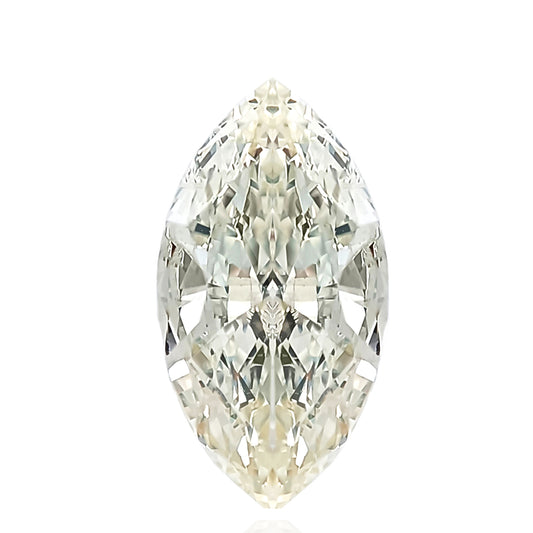 Sold out
Natural Loose Natural Diamond 1ct Faint Yellow M Marquise
Regular price ¥390,000 (Tax incl.)Unit price perSold out -
 Sold out
Natural Loose Natural Diamond 1.002ct Colorless D Marquise
Regular price ¥710,000 (Tax incl.)Unit price perSold out -
 Sold out
Natural Loose Natural Diamond 0.998ct Colorless D Marquise
Regular price ¥450,000 (Tax incl.)Unit price perSold out


How to Choose a Marquise Cut Loose Diamond
What Is a Marquise Cut Diamond
The marquise cut is one of the oldest diamond shapes in continuous production, with origins in 15th century Europe. It is also known as the navette cut — French for "little boat" — for its distinctive elongated outline pointed at both ends. Legend attributes the shape to Louis XV of France, who commissioned a diamond cut to mirror the smile of his companion, the Marquise de Pompadour. The shape carries approximately 56 to 58 brilliant-cut facets and produces sparkle comparable to round cut, while achieving the most dramatic length-to-width ratio of any diamond shape. This extreme elongation makes marquise cut the single most effective shape for visually lengthening the finger or the neckline — it appears longer and larger than a round diamond of equivalent carat weight by a more significant margin than any other fancy shape. Our collection spans E color VVS2 at the top end of colorless grades, through G color SI1 in the near colorless range, to a 1ct M color Faint Yellow stone that occupies an interesting position between the colorless and fancy yellow categories.
Symmetry, Tip Protection, and the Bowtie Effect
Marquise cut shares three key evaluation factors with pear cut, its closest shape relative. Symmetry is the most critical: both pointed tips and the curved sides must mirror each other precisely along the central axis. Asymmetry in a marquise cut is immediately visible, as the shape's extreme length makes any deviation from perfect balance apparent. The certificate's symmetry grade is a useful starting point, but viewing the stone directly is the most reliable assessment. The two pointed tips are also structurally vulnerable — like princess cut corners, they can chip if left unprotected. V-prong settings that cup each tip are standard for marquise cut rings and necklaces; bezel settings offer more complete protection. Finally, the bowtie effect — the dark shadow across the center common to elongated brilliant-cut shapes — is present in marquise cut and varies in intensity by stone. It cannot be assessed from certificate data and must be evaluated in person. Length-to-width ratio of 1.75 to 2.25 is the general recommended range, with higher ratios producing a more dramatic elongation.
The Faint Yellow Stone — Between Colorless and Fancy
The 1ct M color GIA-certified marquise in our collection occupies a genuinely interesting position in the diamond color spectrum. M color sits in GIA's "Faint" range — beyond the Near Colorless grades (G through J) but below the "Very Light" and "Light" grades that approach the official Fancy Color threshold. In practical terms, this stone has a subtle warmth that is visible to the eye — not the strong saturation of a Fancy Yellow, but a distinctive character that sets it apart from colorless diamonds. In yellow gold settings, this warmth reads naturally and can be quite beautiful in a vintage-influenced way. It occupies a unique price position: more accessible than a true Fancy Yellow diamond while offering more character than a colorless stone. If you are considering this stone, viewing in person under both warm and cool lighting is particularly recommended, as the warmth shifts significantly between lighting conditions. Contact us to arrange a viewing.
Frequently Asked Questions
A marquise cut diamond has an elongated outline pointed at both ends, also known as navette or boat shape. It originates in 15th century Europe and carries approximately 56 to 58 brilliant-cut facets. It produces sparkle comparable to round cut while achieving the most dramatic elongation of any diamond shape, making it the most effective shape for visually lengthening the finger and appearing larger than equivalent carat weight in other shapes.
Symmetry is the most critical factor — both pointed tips and the curved sides must mirror each other precisely along the central axis. Length-to-width ratio of 1.75 to 2.25 is the generally recommended range. The bowtie effect (a dark shadow across the center) varies by stone and must be assessed in person. The two pointed tips require V-prong or bezel protection in the setting. On color, D through F is recommended for white gold or platinum settings as the tips can concentrate color.
Yes. Marquise cut, like oval and pear, can exhibit a bowtie effect — a dark, bowtie-shaped shadow across the center of the stone. The degree varies significantly between stones depending on cut angles and proportions, and cannot be assessed from GIA or CGL certificate data alone. Viewing the stone in person in natural light is the only reliable way to evaluate it.
Yes. All marquise cut loose diamonds at Weiss carry GIA or CGL certification, documenting color grade, clarity, carat weight, and symmetry. The symmetry grade is particularly relevant for marquise cut evaluation. Note that GIA does not issue a formal cut grade for marquise cut — that applies only to round brilliant cut.
M color sits in GIA's Faint range, beyond Near Colorless (G through J) but below the official Fancy Color threshold. This stone has a subtle warmth visible to the eye — not the saturation of a Fancy Yellow, but a distinctive character that reads naturally in yellow gold settings and offers a unique position between colorless and fancy color diamonds at an accessible price point. Viewing under both warm and cool lighting is strongly recommended, as the warmth shifts between conditions.
Yes — and for marquise cut in particular we strongly recommend it. Symmetry, the bowtie effect, and tip condition are all most accurately assessed in person. For the Faint Yellow M color stone, viewing under different lighting conditions is especially important. Our appointment-only office is in Okachimachi, Tokyo. Please book an appointment through our contact page or by phone.
Yes. After selecting a marquise cut loose diamond, our craftsmen can create a custom ring or necklace pendant in your preferred setting style and metal. V-prong solitaire settings that cup both tips are the standard recommendation for marquise cut rings. Halo designs and three-stone settings with pear or round side stones also work well. Contact us to discuss your requirements.